Pondy Oxides & Chemicals Ltd (NSE: POCL), the country’s largest lead and lead alloys producer, surged more than 10 per cent in Monday’s trading to ₹1,257.40, marking a breakout that has drawn fresh attention from investors betting on India’s evolving electric vehicle supply chain.
The mid-cap stock, which has climbed nearly six-fold since early 2023, is now testing resistance levels last seen at the peak of its 2024 rally. Market watchers say the move is backed by strong volumes and a steady improvement in fundamentals, positioning the company as a notable beneficiary of the global shift toward battery recycling and sustainable manufacturing.
Battery Recycling Tailwind
Battery Recycling will be a major platform in coming future
POCL has long supplied lead and alloys to India’s battery majors, including Amara Raja and Exide. More recently, it has accelerated investments in recycling and circular economy initiatives, aligning with government priorities on reducing imports of critical materials.
Exports, which account for a rising share of revenue, now reach more than 15 countries. Analysts argue that this global footprint offers a degree of insulation from domestic commodity cycles.
Strong Balance Sheet, Reasonable Valuation
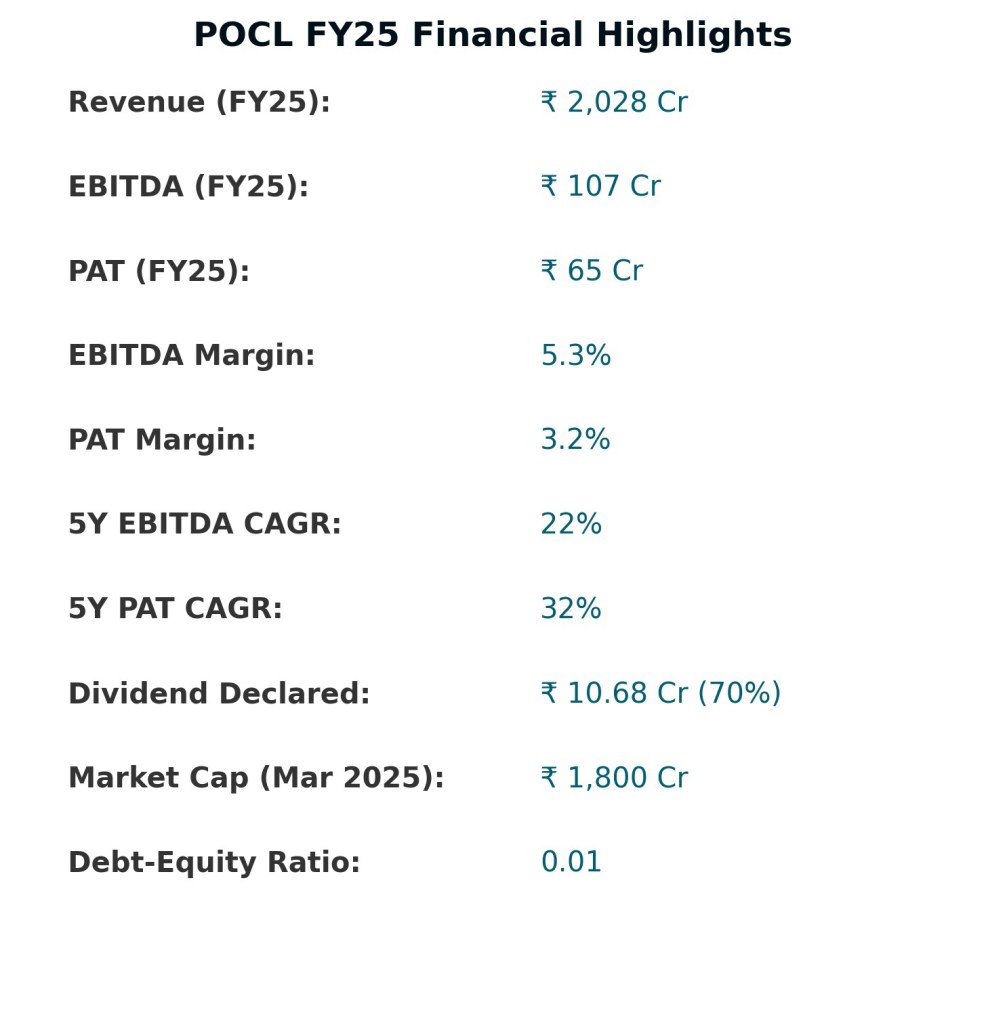
Financial Year-2025
The company’s financial profile underpins investor confidence. With a return on capital employed approaching 20 per cent and promoter holding of over 70 per cent, POCL trades at a modest earnings multiple — roughly 10 to 12 times trailing earnings — well below many specialty chemical peers.
“Valuation remains attractive relative to growth prospects, particularly given the scale of expansion in the recycling segment,” said one Mumbai-based analyst with a domestic brokerage.
Technical Picture
POCL Recent Chart
On the charts, the stock’s breakout has been accompanied by a sharp rise in trading volume, a pattern often viewed as confirmation of institutional participation. If sustained, the rally could carry the stock toward the ₹1,400–₹1,600 range, analysts noted, though profit-taking is likely near historical highs.
Outlook
The near-term performance will hinge on execution in recycling, continued demand from the automotive sector, and any policy incentives under the government’s green manufacturing agenda. Longer term, investors are watching for a potential foray into lithium recycling, which could redefine the company’s positioning in the EV supply chain.
As the monsoon rains breathe life into India’s vibrant landscapes, a wealth of lesser-known vacation spots emerge as hidden gems, perfect for a serene and memorable getaway. These enchanting destinations, tucked away from the hustle and bustle of popular tourist hubs, offer a unique blend of natural beauty, rich culture, and warm hospitality. Whether you’re seeking tranquil nature walks, cultural immersion, or peaceful retreats, these ten destinations are ideal for a visit during June, July, and August. Join us as we uncover these monsoon marvels and inspire your next travel adventure.
1. Lepchajagat, West Bengal
Nestled in the Darjeeling district, Lepchajagat is a tranquil village offering panoramic views of the Kanchenjunga range. Just 19 km from Darjeeling, it’s easily reachable via Bagdogra Airport (88 km) or New Jalpaiguri Railway Station (85 km). The cool, pleasant climate with occasional rain enhances the lush greenery. Stay at the Lepchajagat Tourist Lodge or local homestays, and savor Nepali and Tibetan dishes. Ideal for nature walks and bird watching, Lepchajagat is a family-friendly destination with friendly locals and serene surroundings.
2. Yercaud, Tamil Nadu
Known as the “Poor Man’s Ooty,” Yercaud is a charming hill station in the Salem district. Accessible from Salem Airport (45 km) or Salem Junction (33 km), it boasts a misty climate with moderate rainfall. Accommodations like Sterling Yercaud and Grand Palace Hotel & Spa offer comfortable stays. Enjoy South Indian cuisine and local specialties. Perfect for families, Yercaud offers activities such as sightseeing, boating, and nature walks in a peaceful ambiance.
3. Kausani, Uttarakhand
Kausani, located in the Bageshwar district, is renowned for its breathtaking Himalayan views and lush green landscapes. Reachable via Pantnagar Airport (177 km) or Kathgodam Railway Station (140 km), its cool climate with moderate rainfall makes it ideal for a monsoon visit. Stay at Sun n Snow Inn or Hotel Uttarakhand Kausani and enjoy Kumaoni dishes. Kausani is perfect for families and nature lovers, offering tea garden visits and serene walks.
4. Haflong, Assam
Haflong, the only hill station in Assam, is celebrated for its scenic beauty and rolling hills. Located in the Dima Hasao district, it is accessible from Silchar Airport (100 km) or Haflong Hill Railway Station. The climate is pleasant with moderate rainfall. Stay at Landmark Hotels or Hotel Eastern and enjoy Assamese cuisine. Ideal for families, Haflong offers trekking, bird watching, and cultural experiences in a serene environment.
5. Tawang, Arunachal Pradesh
Tawang, in the Tawang district, is a remote town known for its cultural heritage and stunning landscapes. Accessible from Tezpur Airport (320 km) or Tezpur Railway Station, it offers a cool climate with occasional rains. Stay at Tawang Inn or Hotel Tawang Heights and savor Tibetan and Monpa dishes. Suitable for families and adventure seekers, Tawang offers monastery visits and trekking in a peaceful ambiance.
6. Ziro Valley, Arunachal Pradesh
Ziro Valley, in the Lower Subansiri district, is known for its picturesque landscapes and Apatani culture. Reachable from Tezpur Airport (300 km) or Naharlagun Railway Station (100 km), it offers a cool and rainy climate. Stay at Ziro Valley Resort or Pratigya Ziro and enjoy traditional Apatani dishes. Family-friendly, Ziro Valley offers cultural experiences and nature exploration in a vibrant setting.
7. Gokarna, Karnataka
Gokarna, located in the Uttara Kannada district, is a coastal town with pristine beaches. Accessible from Dabolim Airport, Goa (140 km) or Gokarna Road Railway Station (10 km), it offers a warm and humid climate with moderate rainfall. Stay at Namaste Café or Om Beach Resort and enjoy coastal Karnataka cuisine. Suitable for families and solo travelers, Gokarna offers beach hopping, temple visits, and a peaceful atmosphere.
8. Chopta, Uttarakhand
Chopta, in the Rudraprayag district, is known for its meadows and as a base for trekking to Tungnath. Accessible from Jolly Grant Airport, Dehradun (226 km) or Rishikesh Railway Station (210 km), it offers a cool climate with occasional rains. Stay at Magpie Eco Resort or Chauhan Guest House and enjoy Garhwali dishes. Family-friendly, Chopta offers trekking, camping, and nature walks in a serene setting.
9. Majuli, Assam
Majuli, in the Jorhat district, is the world’s largest river island known for its unique culture. Accessible from Jorhat Airport (20 km to ferry point) or Jorhat Town Railway Station (14 km to ferry point), it offers a warm and humid climate with heavy rains. Stay at Dekasang Resort or La Maison de Ananda and enjoy Assamese dishes. Family-friendly, Majuli offers cultural immersion and nature exploration in a vibrant setting.
10. Mawlynnong, Meghalaya
Mawlynnong, in the East Khasi Hills district, is known as the “Cleanest Village in Asia.” Accessible from Shillong Airport (90 km) or Guwahati Railway Station (172 km), it offers a cool and rainy climate. Stay at Mawlynnong Guest House or local homestays and enjoy Khasi dishes. Family-friendly, Mawlynnong offers a unique experience with its cleanliness, living root bridges, and natural beauty.
These hidden gems in India provide a perfect blend of natural beauty, cultural richness, and serene environments, making them ideal for a memorable monsoon getaway. Whether you’re traveling with family or solo, these destinations offer something unique for every traveler. Embrace the monsoon magic and explore these enchanting locales for an unforgettable experience.
In a move shrouded in secrecy, Turkey has enacted a comprehensive embargo on the export of weapons and defence-related items to India, a decision underscored by its steadfast support for Pakistan, India’s principal adversary in South Asia. This development, which carries profound geopolitical and economic implications, was discreetly sanctioned during a confidential session of the Turkish Parliament.
The revelation of this clandestine policy emerged from a session of the Turkish Parliament’s Foreign Affairs Committee on 10th July 2024. According to the meeting minutes, Mustafa Murat Şeker, the deputy chairman of Turkey’s Defence Industry Agency (SSB), inadvertently disclosed the government’s covert stance on India. Şeker highlighted the sensitivity of the issue, stating unequivocally that no military-related items have been approved for export to India.
Despite concerns about potential fallout if the decision were to become public, Şeker confirmed the existence of the embargo. His remarks were obtained by the Nordic Research Monitoring Network (Nordic Monitor), an organization dedicated to examining issues of terrorism, security, and military affairs.
India ranks among the world’s top arms importers, representing a significant market with annual imports nearing $10 billion. Nevertheless, Turkey’s alignment with Pakistan has led to a complete halt in arms exports to India. Şeker was quoted as saying, “Due to our political circumstances and our friendship with Pakistan, our Ministry of Foreign Affairs does not give us positive feedback on exporting any products to India, and consequently, we do not grant any permits to our companies in this regard.”
Turkey’s defence industry, a sector experiencing rapid growth and involving President Recep Tayyip Erdogan’s family, requires prior approval from the military, the SSB, and the Foreign Ministry for any arms sales. The embargo effectively places India on a blacklist of countries to which Turkey is prohibited from selling military and defence items.
This embargo is a reflection of the deteriorating diplomatic relations between Turkey and India, which have worsened significantly over the past decade under Erdogan’s leadership. Turkey’s unwavering support for Pakistan, particularly in its disputes with India, has further strained ties between the two G20 nations.
Turkey’s secretive assistance to Pakistan extends beyond arms embargoes. According to Nordic Monitor reports, Turkey has been instrumental in various clandestine operations, including the establishment of a cyber army designed to influence public opinion and counter criticism of Pakistan in Southeast Asia. This cyber unit was proposed during private talks in Islamabad between then Turkish Interior Minister Suleyman Soylu and his Pakistani counterpart Shehryar Khan Afridi on 17th December 2018. The plan received approval from Imran Khan, then Pakistan’s prime minister and interior minister, during the same meeting.
The antagonism between Ankara and New Delhi extends beyond the realm of military exports. It encompasses broader strategic choices in global trade. One notable point of contention is Turkey’s opposition to an economic corridor proposal endorsed by India, the United States, and the European Union at the G20 summit in New Delhi. This proposed corridor aims to connect Europe to India via the Middle East through rail and sea routes.
Turkey’s exclusion from this corridor has fueled its opposition to the initiative, perceiving it as a threat to its role as a critical trade hub. The corridor’s potential to favour regional competitors like Greece has further compounded Turkey’s discontent. In response, Turkey has thrown its support behind China’s Belt and Road Initiative, often referred to as the “new Silk Road,” which aligns with its broader geopolitical strategy.
India, on the other hand, has already taken retaliatory measures. Notably, India has revoked a $2 billion naval deal with a Turkish company, indicating the significant economic repercussions of Turkey’s embargo. This move underscores the broader impact of strained relations on defence contracts and bilateral trade.
The ban’s effect on the Indian stock market and defence-based shares has been noteworthy. Defence sector stocks have experienced increased volatility as investors respond to the geopolitical tensions. Analysts have observed fluctuations in the share prices of key defence companies, reflecting uncertainty about future procurement policies and international partnerships. However, this volatility also presents potential investment opportunities for those willing to navigate the risks associated with geopolitical developments.
Additionally, India’s defence exports have reached an all-time high of Rs 21,083 crore in FY 2023-24, reflecting a growth of 32.5% over the last fiscal year. This surge in exports highlights India’s efforts to become more self-reliant in defence production and reduce its dependency on foreign suppliers, a strategic shift that has gained momentum in the wake of Turkey’s embargo.
Turkey’s covert ban on arms exports to India is emblematic of the complex and often contentious geopolitics of the region. Rooted in a historical alliance with Pakistan and driven by broader strategic interests, this embargo signifies a deepening rift between two major players in the global arms market. As Turkey continues to navigate its alliances and strategic objectives, the implications of this decision will undoubtedly resonate across international relations and global trade dynamics.
Exicom is swiftly gaining recognition as a key player in the electric vehicle (EV) charging sector, showing promise akin to the potential of Waaree Renewable. In residential areas, Exicom is responsible for 60% of public charging and 20% of EV charging. The company has secured numerous orders from major EV vehicle manufacturers to establish EV charging points, handling both the manufacture of charging equipment and the engineering work for installation.
The ongoing shift towards sustainable energy has provided Exicom with the opportunity to reshape various sectors. The company is actively advancing the transformation to sustainable energy in mobility and telecommunications through its state-of-the-art technology in EV chargers, battery systems, and industrial power systems. With a presence in 15 countries, Exicom is rapidly expanding, providing innovative solutions across borders. Committed to innovation, Exicom relentlessly pursues positive change, driving technological advancements and making impactful strides in the energy ecosystem.
In addition to its EV charging operations, Exicom has a significant presence in the battery manufacturing sector, particularly for DC supply to mobile towers. This segment has been a major revenue driver in recent years. With the country’s impending transition to 5G connectivity, Exicom’s growth potential is set to increase significantly. The company’s products ensure seamless operations for telecom companies worldwide, 24/7, while helping them reduce their carbon footprint.
Exicom is pushing the boundaries in the EV charger market by making its products future-proof, simple, and reliable, enabling everyone to have the freedom to go electric.
It has only been two months since Exicom was listed on the stock exchange. Compared to the IPO price, the company has already delivered over 100% returns. Since listing, Exicom has provided investors with over 20% returns. With immense growth potential on the horizon, Exicom is a company to watch.
Power Finance Corporation (PFC) has delivered a robust financial performance for the March quarter, reporting an 18.4% year-on-year increase in net profit to Rs 4,135 crore. This impressive growth is complemented by a 20% rise in revenue, which reached Rs 12,243.7 crore, as disclosed in the company’s filing on May 15.
The company’s asset quality showed notable improvement in the final quarter of FY24. Net non-performing assets (NPAs) were reduced to 0.85%, down from 0.9% in the December quarter, while gross NPAs declined to 3.34% from 3.52%. This indicates a strengthened financial position and effective risk management.
In addition to these positive financial metrics, PFC announced a final dividend of Rs 2.5 per share for FY24. This is in addition to the interim dividends of Rs 11 per share already distributed throughout the year, reflecting the company’s commitment to returning value to its shareholders.
Furthermore, Sandeep Kumar, previously the executive director, has been appointed as the chief financial officer with immediate effect, signaling a continuity of experienced leadership within the company.
The market reacted positively to the earnings announcement, with PFC’s stock surging by 4.28% to close at Rs 439.60 on the BSE. This uptick reflects investor confidence in the company’s performance and future prospects.
MarketMogulIN Analysis
PFC’s strong quarterly performance and improved asset quality highlight its resilience and effective management strategies amidst a challenging economic environment. The significant profit increase and robust revenue growth are likely to bolster investor sentiment further. Additionally, the consistent dividend payouts underscore PFC’s stable cash flow and commitment to shareholder returns. With experienced leadership at the helm, PFC is well-positioned for sustained growth and stability in the coming quarters.
Go Digit General Insurance is all set to launch its Initial Public Offering (IPO) worth ₹2,614 crores tomorrow, marking a significant event in the financial market.
IPO Details in a Nutshell
Prominent shareholders, including the celebrated couple Virat Kohli and Anushka Sharma, hold substantial stakes in Go Digit General Insurance. Industry analysts note that the duo is unlikely to sell their shares during the IPO, which adds a layer of stability and confidence to the offering.
Virat Kohli and Anushka Sharma all set to become Multi bagger stock owners
According to the company’s Red Herring Prospectus (RHP), Virat Kohli had acquired 266,667 equity shares at ₹75 per share, amounting to an investment of ₹2 crores. Anushka Sharma purchased 66,667 shares for ₹50 lakhs, bringing their total investment to ₹2.5 crores. This strategic investment by the celebrity couple has seen significant appreciation over time.
The insurance company has set its price band for the IPO between ₹258 and ₹272 per share. Based on the upper end of this price band, the value of Virat and Anushka’s investments would surge by 262%. Virat Kohli’s shares would now be valued at ₹7.25 crores, while Anushka Sharma’s shares would be worth ₹1.81 crores, totaling a combined value of ₹9 crores.
Go Digit Insurance
This significant increase in share value reflects not only the successful growth of Go Digit General Insurance but also the astute investment decisions made by Kohli and Sharma. The upcoming IPO is expected to attract a considerable amount of attention from investors, given the robust financials and growth potential of the company.
For more detailed information and analysis, stay tuned as the IPO unfolds tomorrow.
Have you ever wondered if there are similarities between human behavior and stock market movements?
Let’s explore this intriguing idea.
As a financial researcher, I see parallels between how people behave and how stocks move. Individuals display consistent behavior patterns throughout their lives. By understanding these patterns, we can better predict their future actions and interact with them more effectively.
Stocks, like people, have unique behaviors and movement patterns. No two stocks behave exactly the same way. By closely observing a stock, we can identify its specific patterns and behaviors, which can guide our investment decisions.
So, how do we gain a deep understanding of a stock’s behavior?
The first step is to study the stock’s fundamental movement patterns. Begin by analyzing its historical performance through monthly candle charts. Then, delve into shorter time frames such as weekly, daily, hourly, and minute charts. Conduct thorough backtesting to see how the stock has performed in the past, and follow this with forward testing over several weeks to understand its recent movements.
This comprehensive approach helps us accurately capture the stock’s behavior patterns.
We must also consider the psychological factors that influence stock movements. Each movement period of a stock is often based on previous trends. By understanding this, we can better anticipate future movements. Even when unexpected drops occur, it’s important to remember that the stock’s past behavior can give us clues about its future actions.
Psychology plays a major role, driving around 70% of market movements. Observing these psychological factors closely can provide significant insights.
In addition to psychological factors, it’s crucial to learn and apply various technical analysis methods and fundamental analysis to assess a stock’s value. Price action rules and indicators can help us determine the best times to buy and sell.
By testing these strategies on various stocks over a few months, we can improve our ability to select stocks, make informed entry decisions, and determine effective exit strategies.
With experience, selecting stocks and making quick, informed decisions becomes easier, enhancing our overall investment approach.